Qualifying customers for incentives
Qualifying customers and measuring value is what enables incentives to influence purchase decisions. See how eligibility and value are calculated across over 200 active programs.
See how this maps to the APIFor an incentive to help drive a purchase decision, the customer needs to see the value quickly in the context of the equipment or project cost. Many tools today rely on sharing program names with a link for the customer to learn more.
This is ineffective. Customers have to leave the site and do research on their own. It’s not reasonable to ask customers to sift through utility webpages and terms and conditions PDFs. The incentive offer needs to be embedded, in dollars, inside the checkout process.
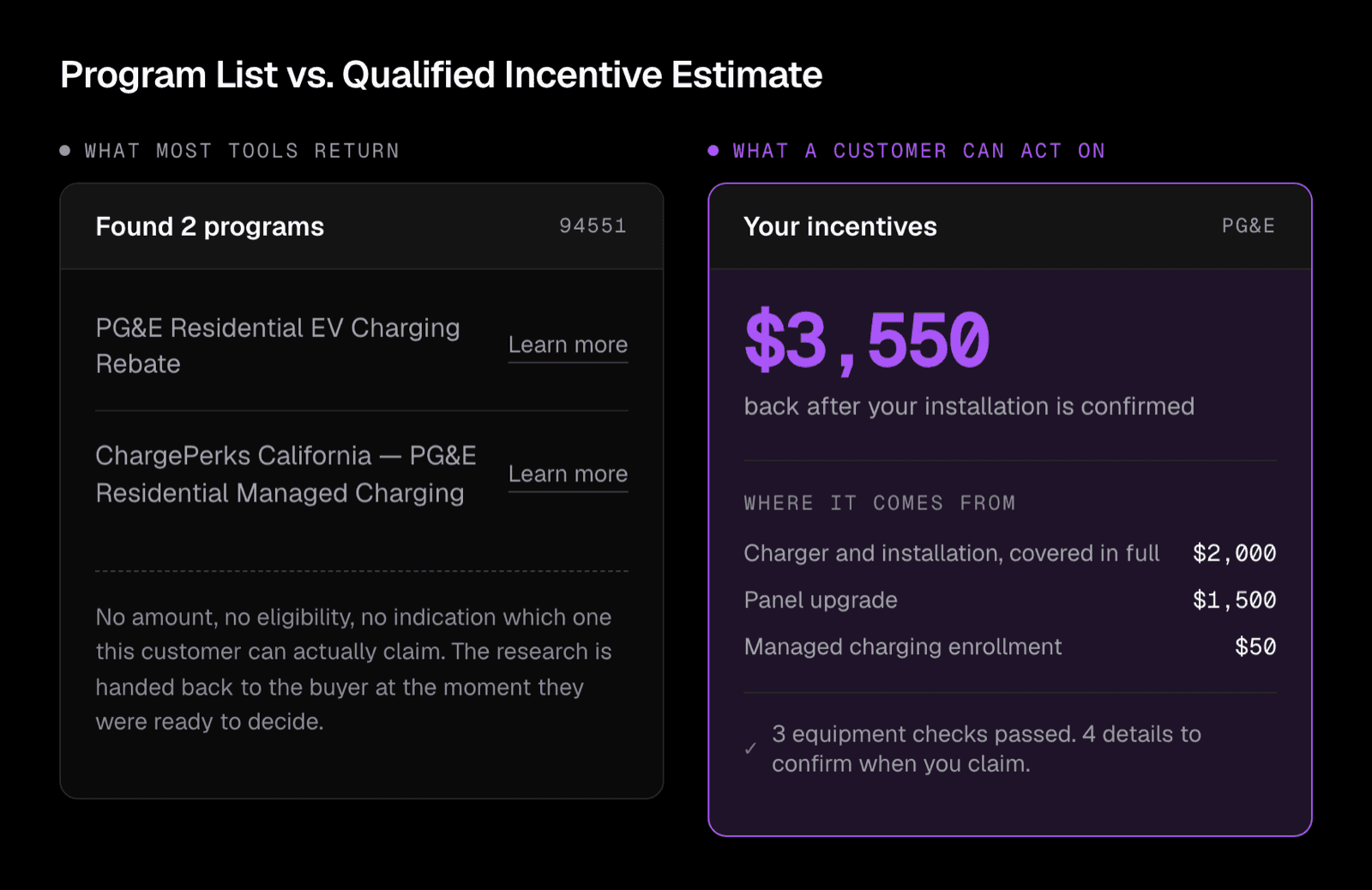
Across more than 60 companies we’ve talked to, sales leaders have expressed concern about getting the value wrong. Mis-set expectations come back as support tickets or one-star reviews. Up to this point, the extra value hasn’t been worth the risk.
We’ve now modelled over 200 incentive programs from the source materials. This post shares the trends we’ve observed across these programs, including how to qualify eligibility and calculate accurate incentives, and offers tips for displaying clear incentive amounts to your customers.
- 209
- programs measured
- 61
- unique requirement checks
- 7
- median checks per program
- 4
- methods to compute an amount
Start with the utility
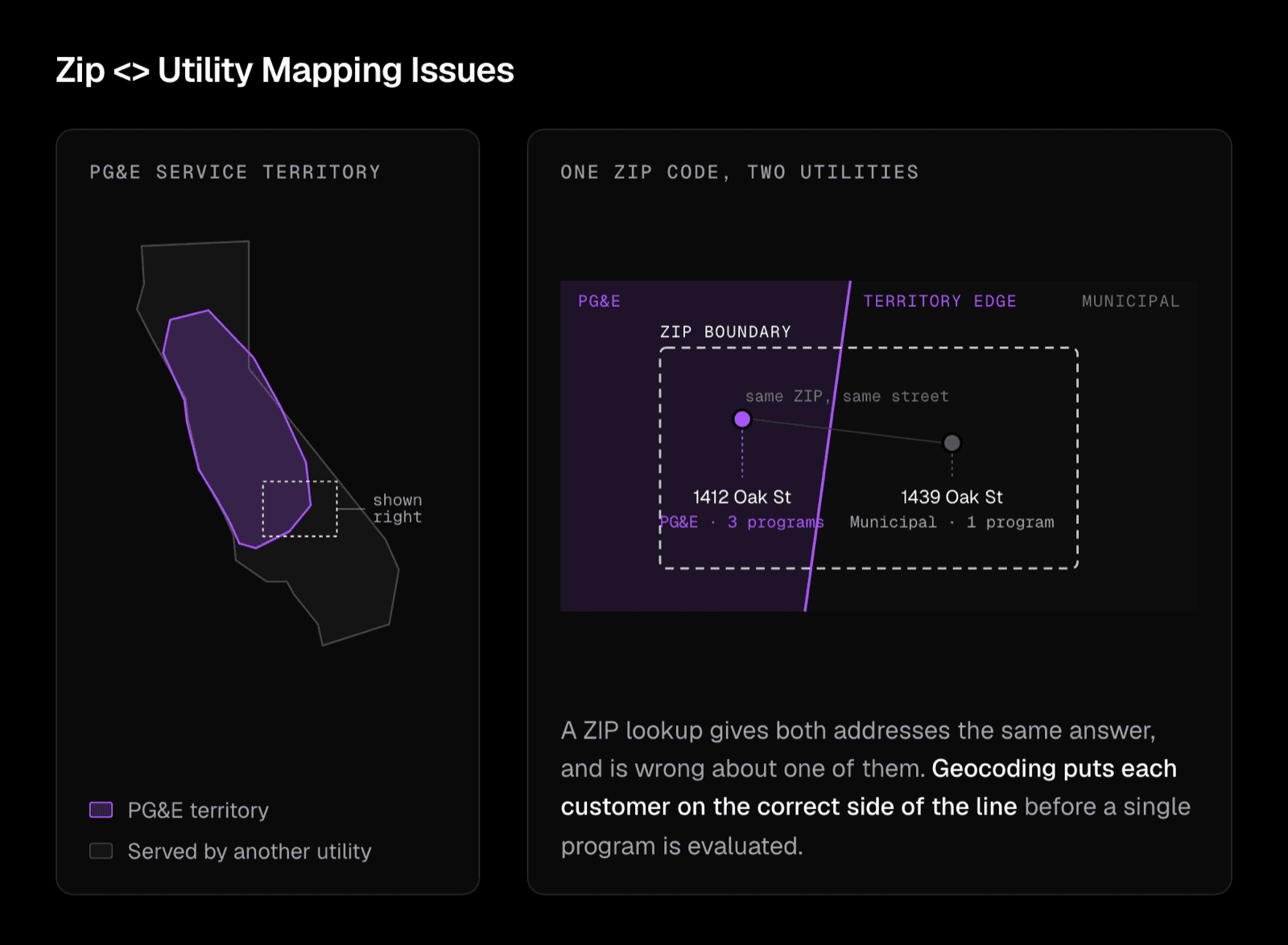
Surfacing the right incentives depends on finding the customer’s utility.
ZIP codes have become the industry norm, but are too coarse to be effective in a point of sale. For example, one in eight people across 11 Mid-Atlantic utilities lives in a ZIP code split across two or more utility service territories.
Two kinds of requirement
The eligibility engine reads first-party program sources: terms and conditions, program web pages, application forms, approved product lists. Each requirement check it produces reports a status and a severity. Severity splits every requirement into two groups.
Blocking requirements are settled up-front. Checks against the equipment specs are resolved pre-sale. Example checks include charger level, power rating, certifications and networking capability from the device catalog. When a program requires something the device does not have, we say so before the sale.
Pending requirements are communicated up-front but settled during the application process. Many rules should be shared with the customer as fine print, but shouldn’t block the sale. Things like utility account status, permit requirements, and acceptance of program terms can all be resolved during the installation or claiming process. These checks are displayed, but do not affect eligibility until they’re definitively set by the seller or customer.
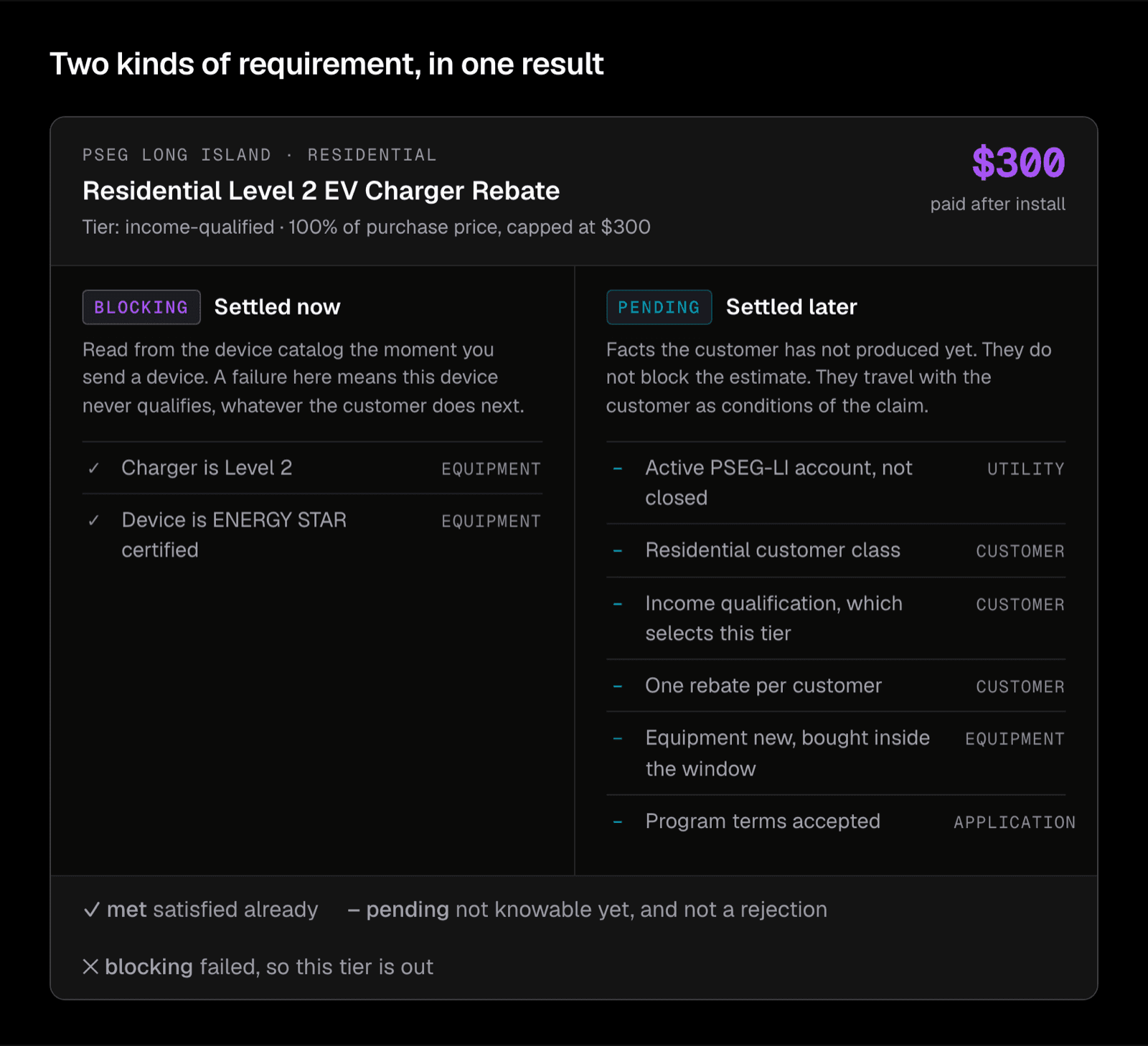
26% of all requirement checks are blocking and 74% are pending. 189 of the 209 programs carry at least one blocking equipment gate, and all 209 carry pending conditions.
What programs ask about
Across the current program fleet, we use 61 distinct checks to cover everything a program can ask.
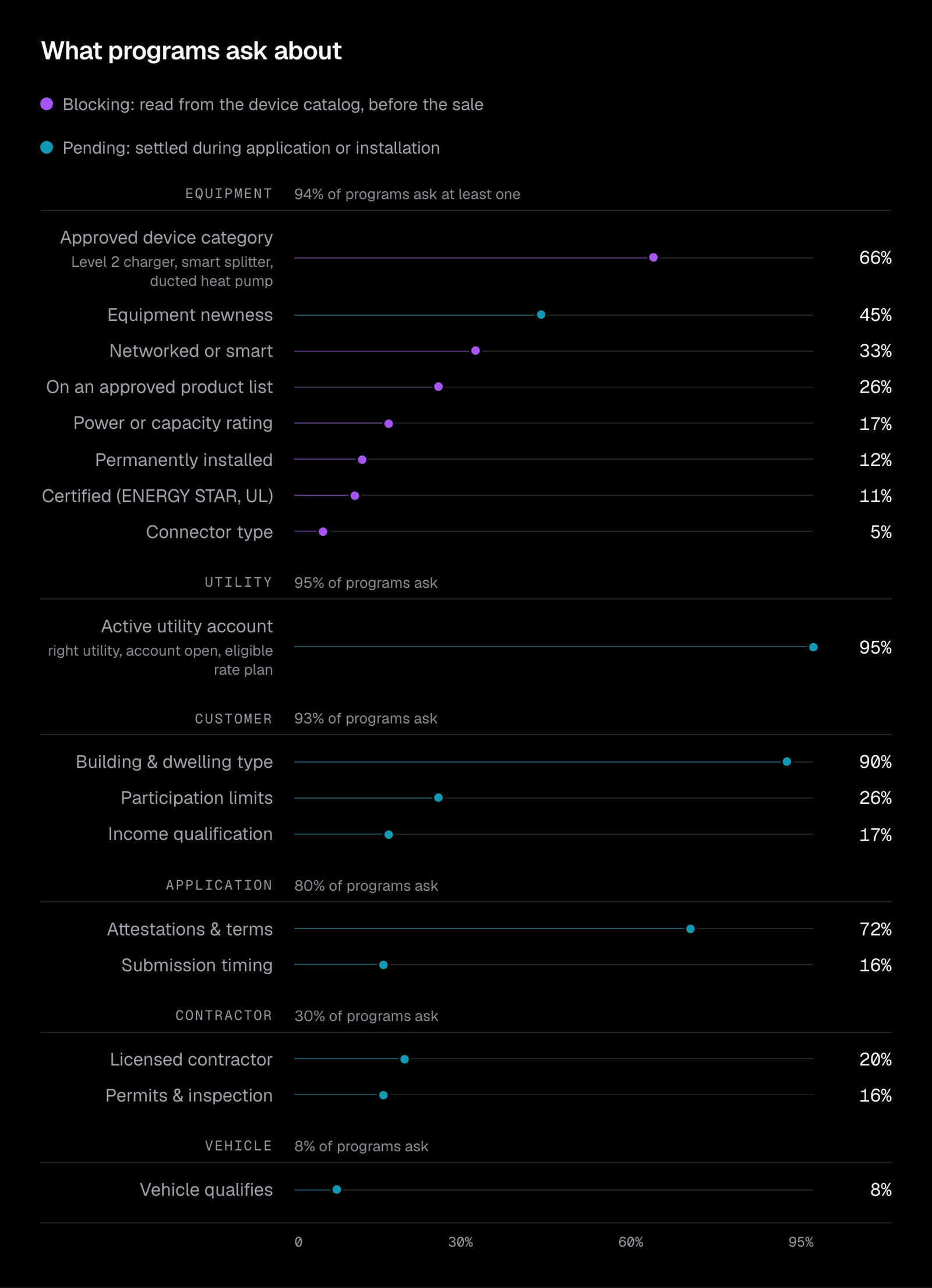
Two thirds of programs test whether the device is the approved category of equipment at all: a Level 2 charger rather than a portable cord set, a networked thermostat rather than a programmable one.
About a quarter of programs also restrict which equipment can claim. 17% (36 programs) enforce a strict approved product list published by the utility, and no equipment outside the list qualifies. We track those lists, currently 2,560 approved products, and check the customer’s equipment against them by device rather than by matching model-name strings. The median list holds 10 models. At the high end, PG&E’s battery storage program holds over 1,000. Beyond APLs, another 19 programs (9%) restrict by manufacturer or model without publishing a list. Remaining programs evaluate based on specifications, so any model can qualify if it meets the required technical specs.
Programs pay in tiers
A tier represents one payment a program can make. Each tier carries its own requirements, amount and schedule.
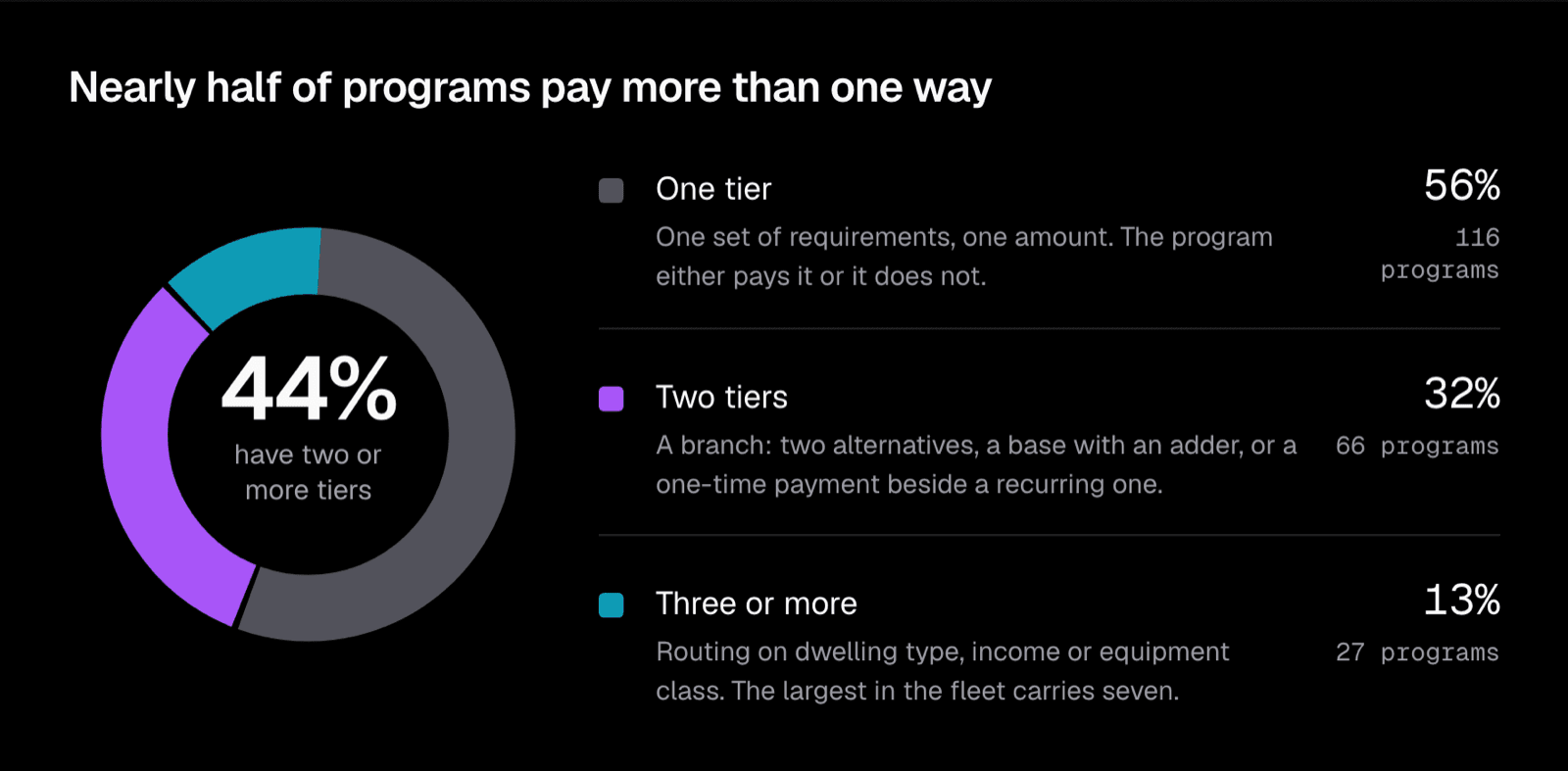
Among the 93 programs with more than one tier, the relationship between those tiers determines the amount.
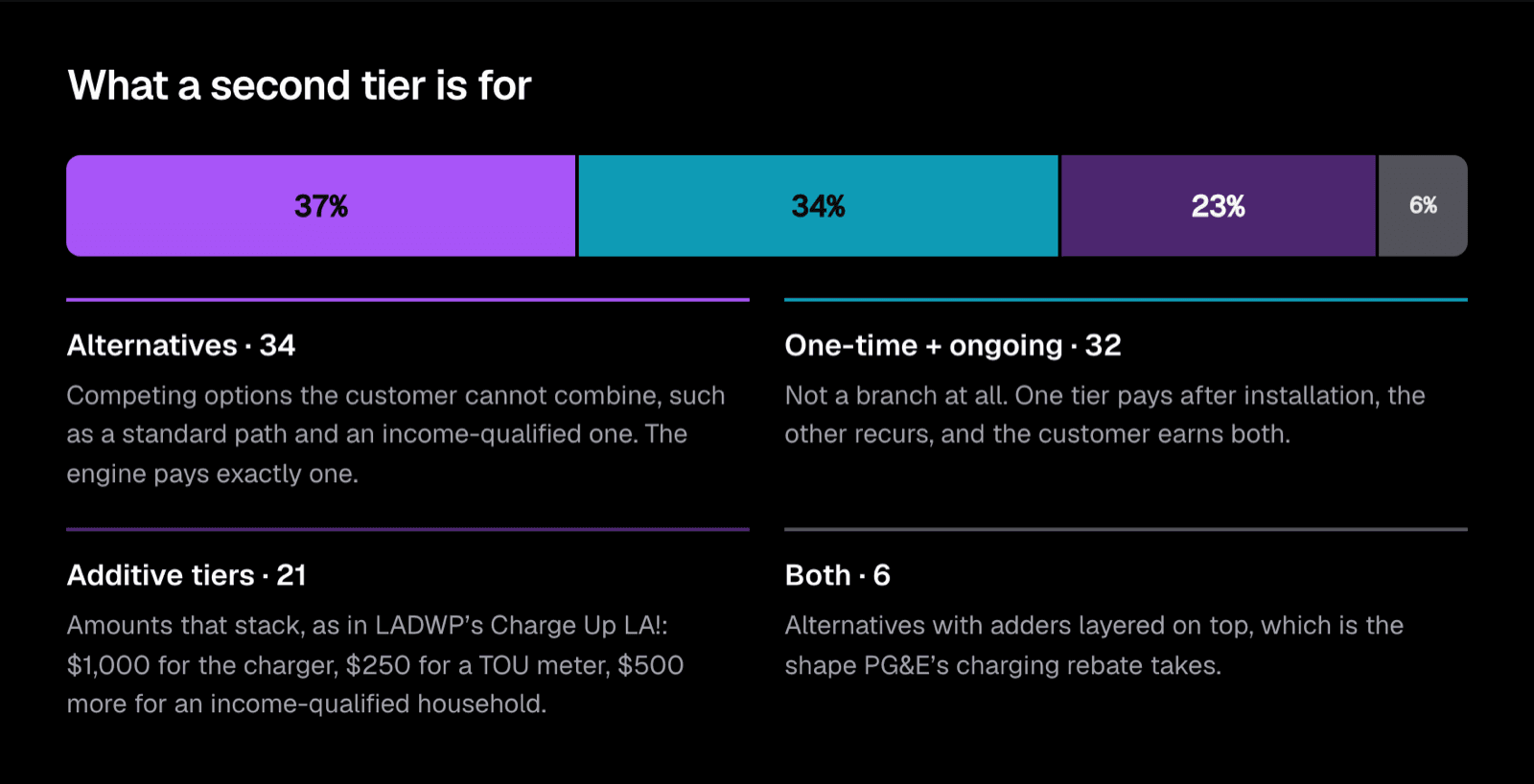
Alternatives are competing options the customer cannot combine. A standard tier and an income-qualified tier on identical equipment is the classic case. 34 of the 93 work this way, and a branching program almost always offers exactly two options.
Additive tiers add together. LADWP’s Charge Up LA! pays $1,000 toward the charger, $250 more for a time-of-use meter, and $500 more for an income-qualified household. 21 programs are built this way, and some of those adders never pay on their own.
One-time and ongoing payments commonly coexist. In 32 programs the customer earns both. This is even more prevalent when stacking rebates alongside VPP participation.
PG&E’s Residential EV Charging Rebate shows how these tiers can work together at multiple levels: two alternatives, one adder, delivered as a single incentive amount with the eligibility details attached.
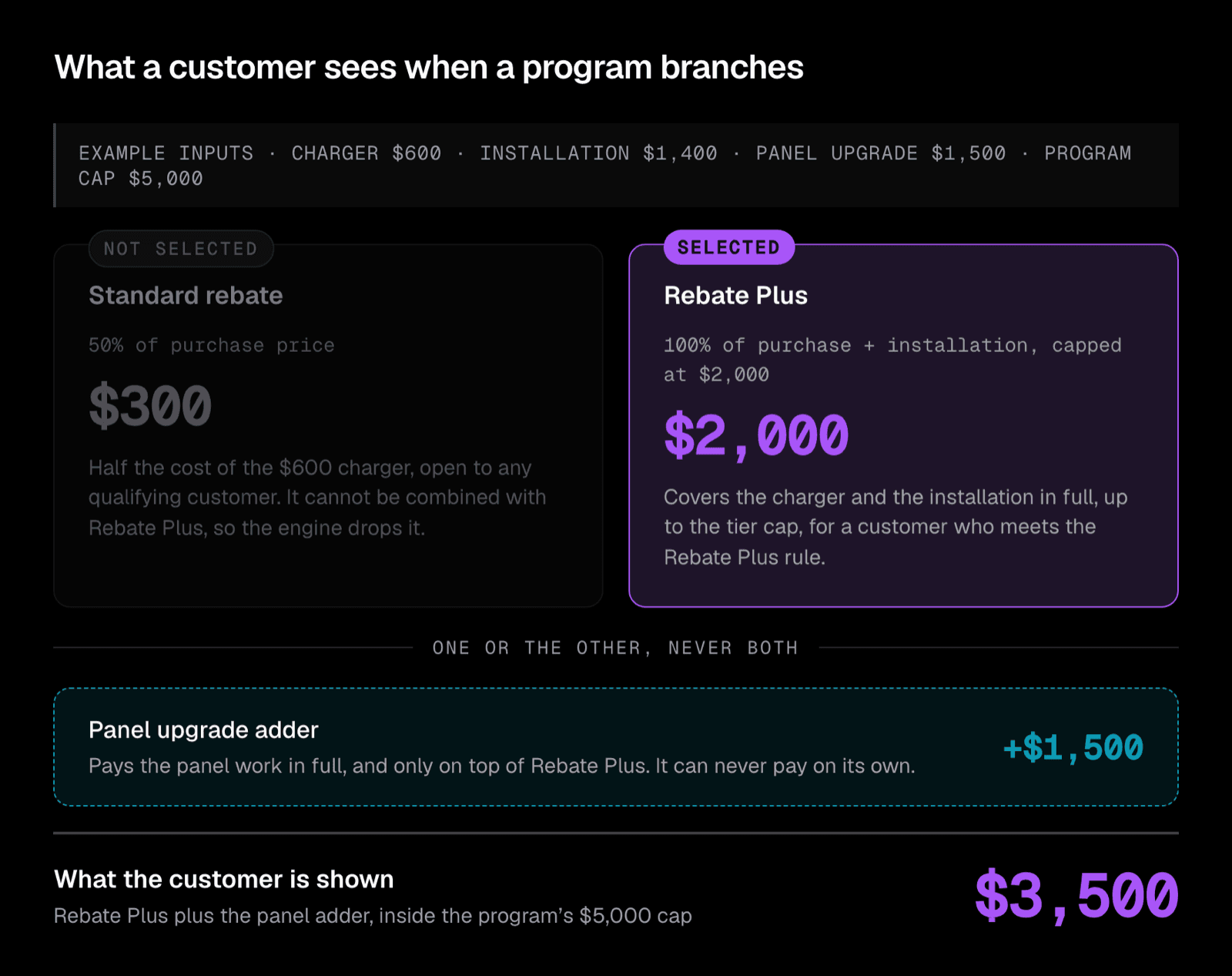
National Grid Massachusetts runs seven tiers. Six are mutually exclusive wiring rebates routed by dwelling type and income, capping at $700, $1,000, $1,400 or $2,000, plus an independent smart charger tier. An integration that assumes one program means one amount is wrong there by up to $1,300 before the charger rebate is counted.
Methods, caps, and timing
Programs use different calculation methods to decide their incentives.
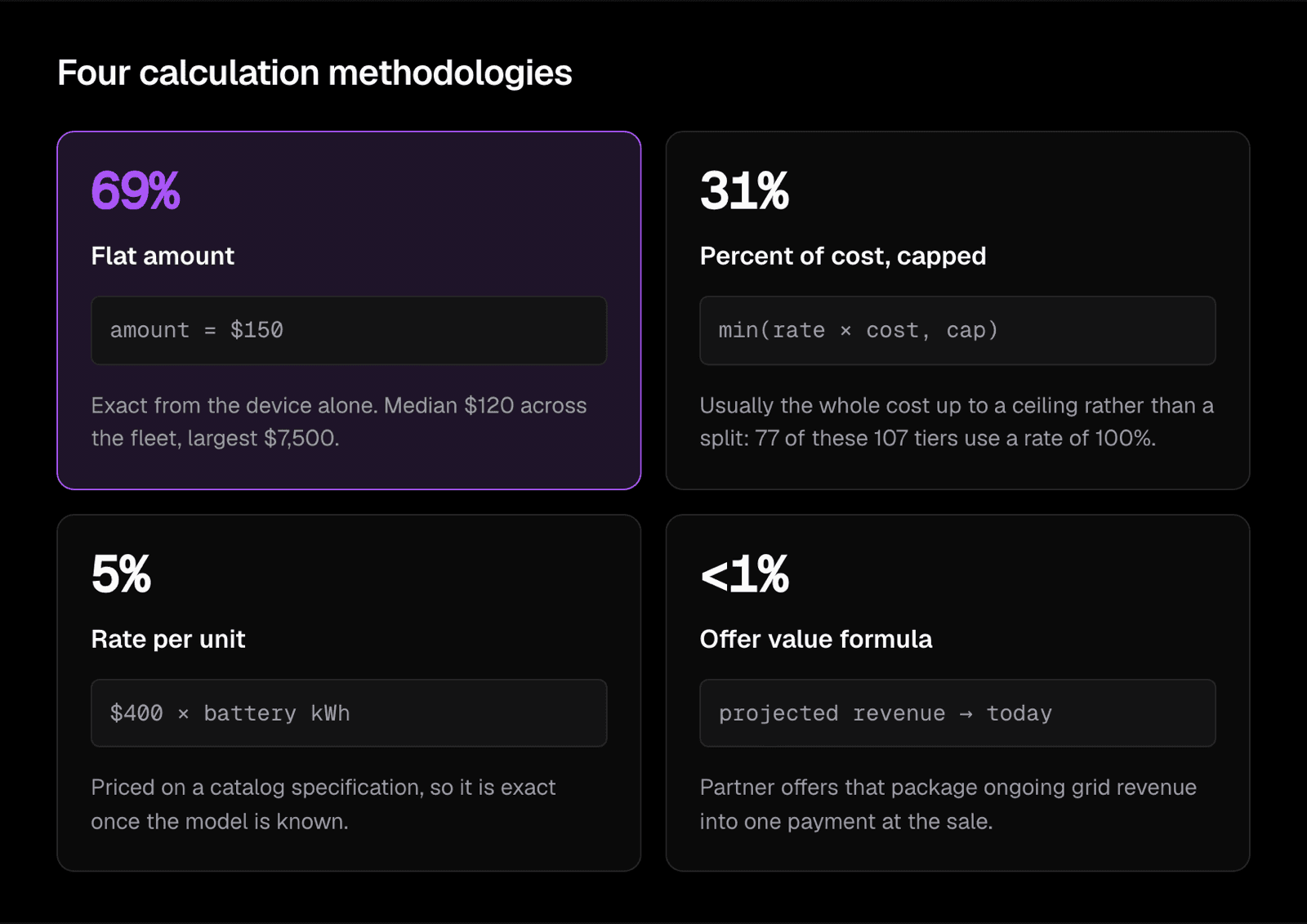
Percentage tiers provide a share of the purchase or installation cost as an incentive. These cost-based methods can complicate a quote before the sale. 80 programs (38%) compute the amount from purchase price, installation cost, or both, and neither is a fixed property of the product. We fill that gap with catalog MSRPs and regional installation estimates, so a percentage-based program still returns an amount before any invoice exists, and the estimate is replaced with the real cost once the customer provides it.
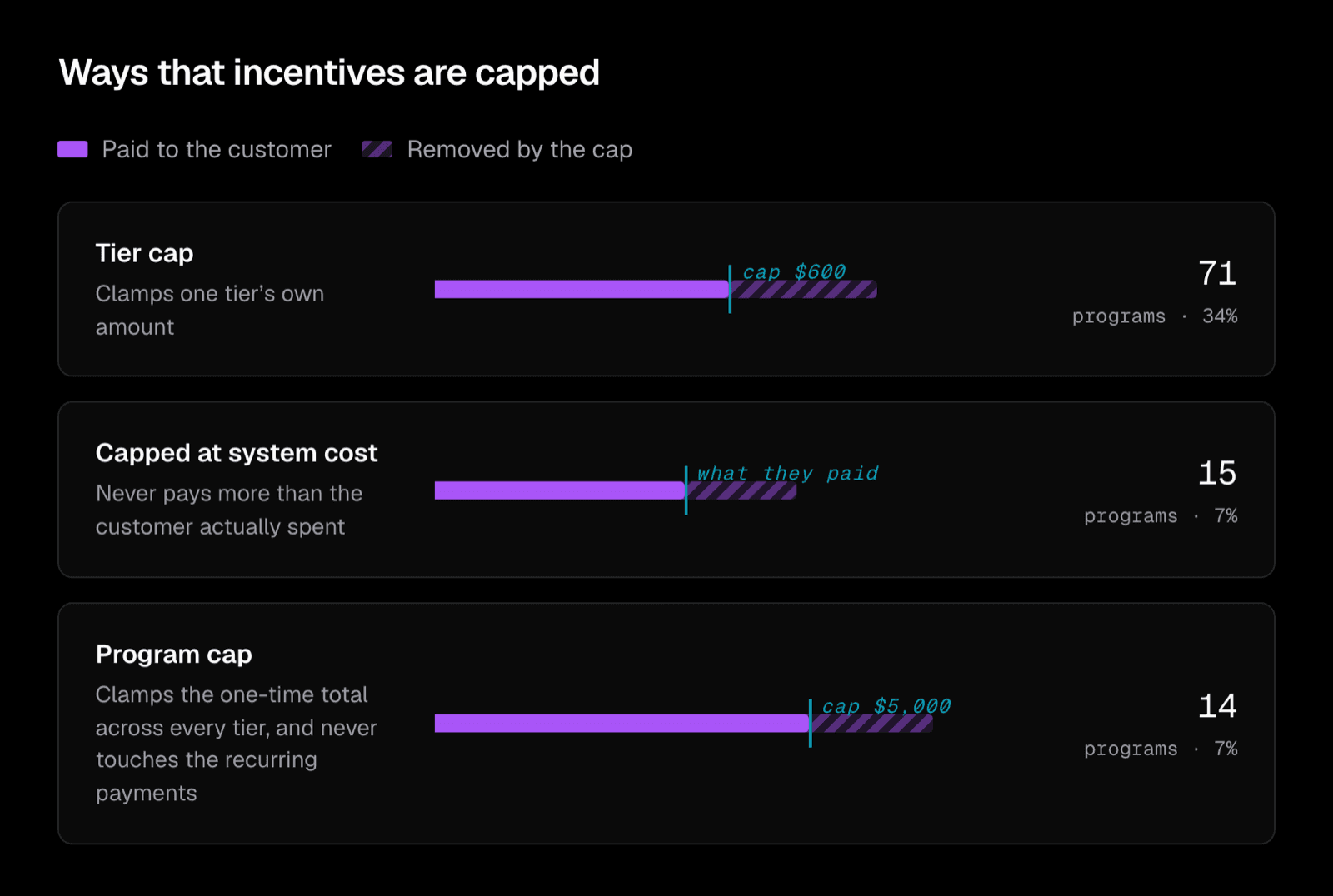
Timing divides the money again. 92% of programs pay once, after purchase or installation. A quarter pay something recurring, and 17% (35 programs) do both.
Tips for exposing incentives to customers
These are the choices we’ve found make the biggest difference when building incentives into a sales channel:
Show the dollars, not the program name. A program appearing in the response does not mean the customer qualifies for it. We return programs that were evaluated and failed, with the reasons, because those reasons are useful. Gate your display on the tier results, not on whether any programs came back.
Separate one-time money from ongoing money. Show what comes off the price today, what arrives after the install is confirmed, and what recurs every year.
Route your display on the check category. Focus customers on what they’ll be responsible for completing. If you pull permits for the customer, mark the permit and contractor checks “handled by us” or leave them out.
Use the hierarchy the API provides. Progressively disclose incentive amounts from the customer level, then program, then tier, then requirement. The headline number belongs at the customer level.
All of the diversity listed above is handled in a consistent structure within our API. If you are integrating, the API guide maps each piece of that structure to the response you get back.
Try the Incentives Gateway
The first 1,000 lookups are free during the beta. Create an account, or read the API reference first.
Running an A/B test, or wiring a sales channel into VPP enrollment? Talk to us at incentives@leap.energy